HIMACS Thermoforming FAQ
Q. What is thermoforming and why is it used with HIMACS?
Thermoforming is the process of heating HIMACS sheets until they become flexible enough to be moulded into curved or three-dimensional shapes. Once cooled, the material retains the new form with excellent structural integrity, enabling creative and functional designs that maintain HIMACS’ durability and seamless appearance.
Q. What is the ideal temperature range for thermoforming HIMACS sheets?
The recommended heating range is typically 150–170°C, depending on sheet thickness and colour. Temperatures below this may cause insufficient flexibility, while higher levels can result in surface blistering, colour change, or loss of mechanical strength.
Q. How should HIMACS sheets be heated for thermoforming?
Sheets should be placed in a dedicated thermoforming oven that distributes heat evenly on both sides. The material must be heated gradually to reach uniform temperature throughout its thickness. Localised heating methods, such as heat guns or open flames, are not recommended as they cause uneven softening and deformation.
Q. How long does a HIMACS sheet need to remain in the oven?
Heating time varies depending on sheet thickness, size, and oven performance. As a general guideline, allow one minute per millimetre of thickness once the oven has reached the target temperature. For example, a 12 mm sheet typically requires about 12 minutes to achieve full flexibility.
Q. What type of moulds are suitable for HIMACS thermoforming?
Use heat-resistant moulds made from materials such as MDF, aluminium, or plywood treated for high-temperature applications. The mould must be perfectly smooth, clean, and free from dust, as any surface imperfection may transfer to the HIMACS sheet during forming. Apply a suitable release film or paper if needed.
Q. How should formed HIMACS parts be cooled?
After shaping, allow the material to cool slowly and uniformly while still in the mould to prevent warping or internal stress. Forced cooling with fans or cold air is not recommended. Cooling should continue until the sheet reaches room temperature and regains rigidity before removal.
Q. Can all HIMACS colours and patterns be thermoformed?
Most HIMACS colours are suitable for thermoforming. However, dark or heavily pigmented colours may require extra attention to heating and cooling times to prevent visual inconsistencies or surface distortion. Always conduct a small-scale test before large-batch production.
Q. What is the minimum radius that can be achieved when thermoforming HIMACS?
The achievable bending radius depends on the sheet thickness:
12 mm sheet: minimum inside radius ≈ 150 mm
9 mm sheet: minimum inside radius ≈ 75 mm
6 mm sheet: minimum inside radius ≈ 30 mm
Reducing thickness allows for tighter curves, but excessive bending can lead to whitening or cracking.
Q. What precautions should be taken during thermoforming?
Always pre-clean sheets to remove contaminants.
Avoid overheating or uneven heating zones.
Ensure proper ventilation in the oven area.
Do not stack multiple sheets during heating.
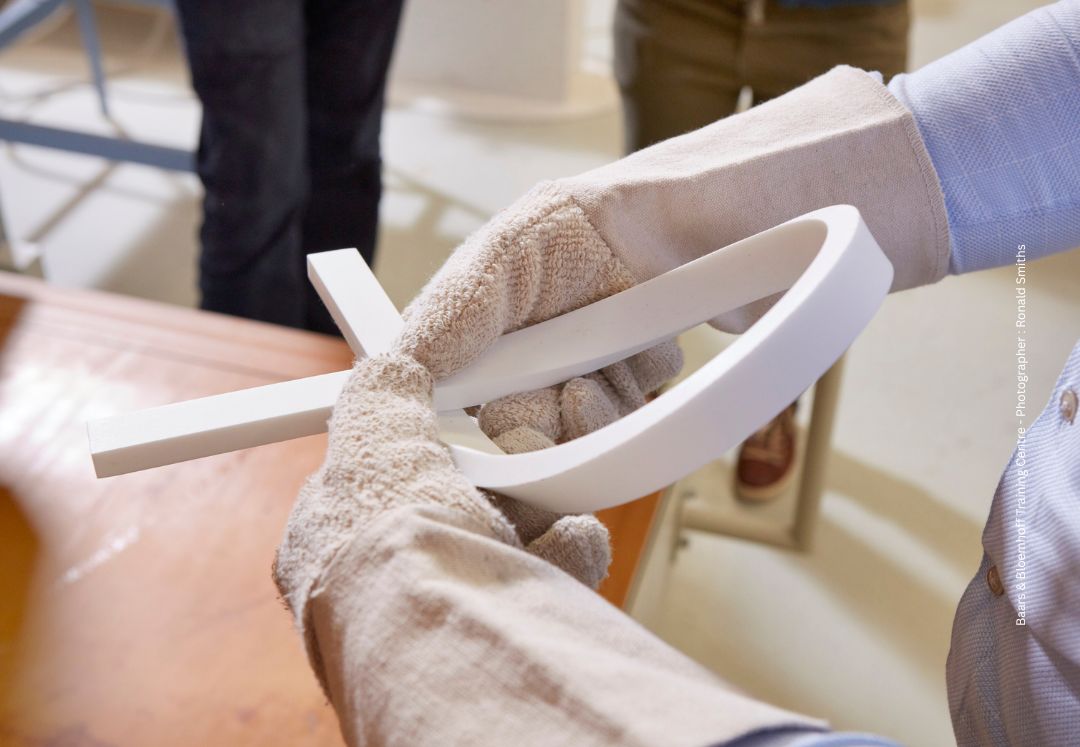
Handle the softened sheet with heat-resistant gloves to avoid surface marks.
Q. Can thermoformed HIMACS parts be joined or seamed after forming?
Yes. Once cooled and stabilised, thermoformed parts can be bonded using standard HIMACS adhesives. Proper edge preparation and sanding are essential to achieve invisible seams and maintain structural strength.
Q. What are best practices for reinforced seams under heat exposure?
In areas exposed to heat (e.g., near cooktops), bevel the reinforcement strip edges to 45° to reduce stress points. Ensure full adhesive coverage and a tight bond. Smooth and sand all edges to prevent cracks or delamination due to thermal expansion.
Q. How should HIMACS sheets be prepared before thermoforming?
HIMACS sheets must be stored at room temperature for at least 24 hours before thermoforming to ensure dimensional stability. If sheets were transported or stored in cold conditions, allow sufficient time for acclimatisation. Always remove the protective film, inspect the surface for defects, and cut oversized by 25 mm to 7% to compensate for shrinkage during forming.
Q. Why is it important to avoid pre-processing operations before heating?
Pre-processing such as drilling, machining, or joining before thermoforming can cause cracking, distortion, and uneven forming due to stress concentration and thermal inconsistency. Only essential cutting and minimal machining should be performed prior to heating. All other fabrication work must take place after thermoforming to preserve material integrity.
Q. What are reference points, and how do they improve forming accuracy?
Reference points are alignment marks placed on both the HIMACS sheet and the mould. They ensure precise positioning during forming, improve repeatability, and simplify post-forming trimming and assembly. For best results, use at least three clearly visible reference points and verify alignment before heating begins.
Q. How can colour or surface inconsistencies be avoided during heating?
To maintain consistent colour and surface finish, ensure uniform oven temperature and cleanliness. For small heating areas, use a helper piece to maintain even pressure between heating plates. When flat and thermoformed parts are part of the same project, heat both simultaneously to achieve uniform pigment response and texture.
Q. What are the key forming and cooling guidelines for HIMACS?
Begin forming immediately after removing the sheet from the oven while it is still flexible. Ensure the mould is clean, positioned correctly, and clear of obstructions. Allow the formed sheet to cool naturally on the mould until it reaches about 60°C. Avoid forced cooling, which can cause cracking or shape distortion.
Q. How should thermoformed HIMACS parts be trimmed and finished?
After forming, trim to final dimensions using a handheld router or CNC machine depending on complexity. Consider creating a duplicate mould for trimming to avoid damaging the original. For surface finishing, use soft-backed sandpaper and follow the official HIMACS Finishing Guidelines for consistent sanding and polishing quality.
Q. Does thermoforming affect material thickness?
Yes. In vacuum pressing processes, areas under high stretch may experience material thinning. To maintain strength, plan mould design carefully and reinforce or support thin sections after forming. Avoid forming sharp internal corners, which may lead to cracks or long-term material fatigue.
Q. What are the main principles for successful HIMACS thermoforming?
Always plan and document the full thermoforming process.
Operate within the recommended temperature and radius limits.
Use only ovens and moulds designed for uniform heat distribution.
Keep the workshop environment stable (15–25°C).
Follow validated procedures for consistent, high-quality results.
This guideline has been created to provide technical information for successful fabrication and installation of HIMACS, and it is intended to be used in a safe environment considering their own discretion and risk by who has technical skill for fabrication and installation of HIMACS.
This guideline is continually revised to provide reliable and up-to-date information, replacing all previous versions of the guideline and technical information, however the usage and conditions of use are beyond LX Hausys control, LX Hausys cannot guarantee the suitability of material, fabrication and installation for all usage and conditions of use. Users should not regard or rely on this guideline as a complete, sole, up-to-date or absolute information. HIMACS users, fabricator and installer should review whether the design for HIMACS, fabrication method, installation method and required performance are suitable for the intended use and conditions of use. LX Hausys shall not be liable for any direct or indirect, commercial damages or losses caused by the fabrication and installation results of HIMACS using any or all these guidelines. In addition, the results of joining with other materials, and the fabrication and installation guidelines for other materials shall not be covered by LX Hausys.
This guideline does not encourage to violate any laws, patents and licenses, and cannot be used as a basis for legal liability. All works on / from HIMACS must be performed in accordance with related laws and regulations.
LX Hausys reserves the right to change the technical information and disclaimers in this guideline for technical development and further information, and the use of HIMACS or this guideline is considered to accommodate the information and changes provided in this guideline. Therefore, please check the changed details of this guideline from time to time.
LX Hausys reserves all information in this material, and no reproduction or alteration is permitted in any way for all or any part of the information without the official written permission of LX Hausys.