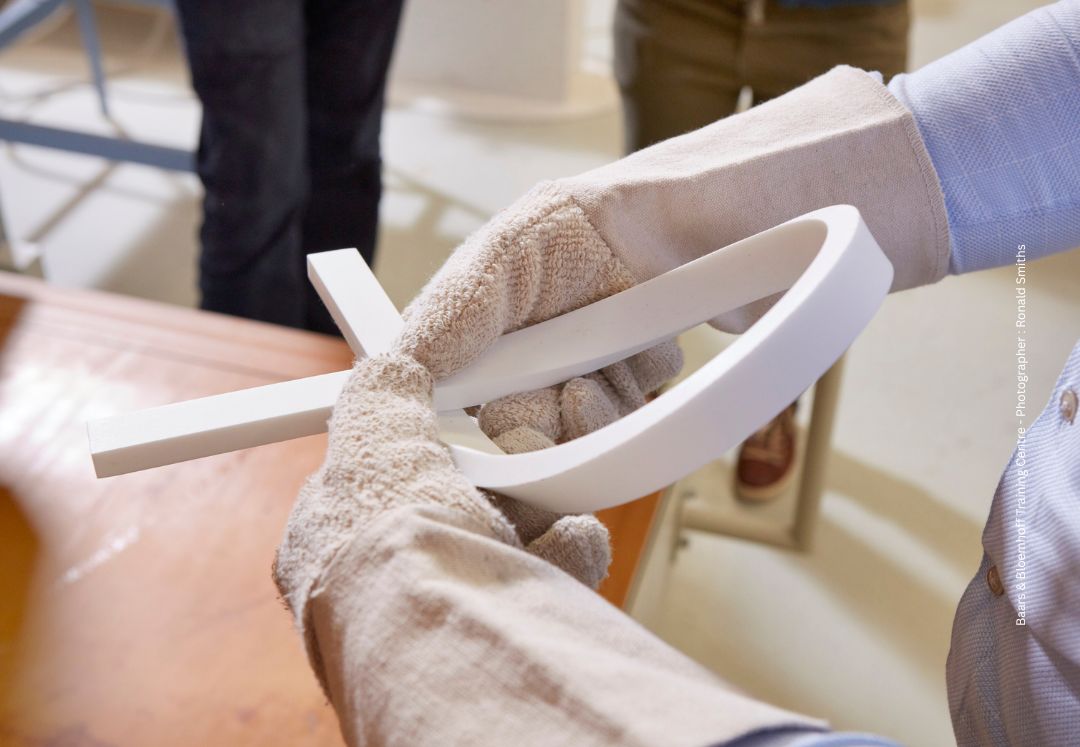
1. Thermoforming
HIMACS Material Properties and Thermoforming Technology
HIMACS possesses unique material properties that allow it to be thermoformed into two- or three-dimensional shapes through a controlled heating process. This enables the creation of curved and complex designs. However, the 3D thermoforming process cannot be precisely standardised due to the diversity and complexity of potential applications.
Various parameters can influence the thermoforming process, each affecting the final appearance and characteristics of the finished product. Thermoforming is considered one of the most advanced fabrication techniques available for HIMACS, offering significant scope for creative expression.
To ensure optimal results in thermoforming, LX Hausys Europe GmbH, in collaboration withGLOBAL MACHINES / NABUURS DEVELOPMENT, provides a comprehensive range of tools and accessories tailored to support your thermoforming activities.
Please visit the website : www.globalvacuumpresses.com
.png)
.png)
Definition: What is Thermoforming?
Thermoforming is a plastic manufacturing process that utilises pressure, heat, or vacuum force to stretch thermoplastic material over a mould, forming a three-dimensional shape, component, configuration, or other plastic product.
HIMACS belongs to the thermoplastics group due to its molecular structure. Through a preheating process, it can be transformed into a thermoelastic material, allowing it to be shaped accordingly.
Please note that LX Hausys Europe GmbH does not cover any material defects or unsatisfactory results arising from the thermoforming process under its warranty.
Safety
During the thermoforming process, HIMACS reaches very high temperatures. It is essential to protect all parts of your body and to ensure the safety of your colleagues and surroundings to prevent injury. All applicable safety rules and regulations in your area must be strictly observed.
Important Information Regarding HIMACS Quality
Although LX Hausys exercises great care throughout the manufacturing and post-production processes of HIMACS, it is strongly recommended that a visual inspection of the product be carried out prior to use.
It is also advisable to record the following details for quality assurance and traceability purposes:
Product traceability: Sheet number / batch number
Thermoforming parameters: Temperature / duration / pressure
Ambient conditions: Temperature and any other relevant environmental factors
2. Material Characteristics
2.1. Condition Of Deformation
Thermoforming HIMACS Sheets
HIMACS sheets can be transformed from a rigid state into a flexible form through heating at the appropriate temperature and duration. This allows the material to be shaped without cracking or breaking. Therefore, achieving successful thermoforming results depends critically on using the correct heating conditions.
For HIMACS sheets with a thickness of 12 mm, the recommended heating temperature ranges between 155°C and 175°C, with a heating time of 12 to 30 minutes.
However, these parameters should be carefully adjusted based on:
The thickness of the HIMACS sheet
Ambient workshop temperature
The performance and characteristics of the heating equipment used
It is important to note that insufficient or excessive heating can lead to thermoforming failure. Never exceed a temperature of 204°C, as this may result in:
Discolouration
Burning
Cracking
Reduced durability of the final product
HIMACS sheets transition from a rigid to a flexible state when heated under appropriate conditions, allowing them to be shaped without damage. The key to successful thermoforming lies in applying the correct temperature and duration.
THERMOFORMING CONDITIONS
HIMACS THICKNESS | HEATING TEMPERATURE | HEATING TIME |
|---|---|---|
6 mm | 155 °C to 175 °C | 6 to 20 minutes |
12 mm | 155 °C to 175 °C | 12 to 30 minutes |
These values should be fine-tuned based on factors such as sheet thickness, ambient workshop temperature, and the performance of the heating equipment used.
Important Note:
Do not exceed a temperature of204°Cwhen heating HIMACS sheets. Excessive heat may cause discolouration, burning, cracking, and a reduction in product durability.
Cooling Conditions for Thermoformed HIMACS Sheets
Once HIMACS sheets have been heated and shaped, they must be cooled under appropriate conditions to maintain their integrity.
The material remains pliable above 60°C, and cooling too rapidly may cause thermal shock, potentially leading to cracking or breakage.
To prevent unintended deformation or damage, thermoformed HIMACS sheets should remain secured under pressure on the mould until they have cooled to 60°C.
This cooling process should take place at room temperature over a period of approximately 40 to 60 minutes.
2.2. Limitations of thermoforming HIMACS Sheets
While thermoforming enables the realisation of imaginative and inspired designs, HIMACS sheets do have certain limitations that must be considered.
The process may result in slight dimensional and visual changes, such as alterations in thickness, colour, or pattern.
Excessive bending can lead to cracking, tearing, or chipping of the base material.
When HIMACS sheets are thermoformed into curved shapes, the bent areas typically become thinner than the original sheet, and the pattern may stretch.
A whitening effect—where the colour lightens, often turning white—can occur. This effect is more pronounced in tighter curves and darker colours.
Fabricators must be aware of and adhere to the limitations of thermoforming HIMACS sheets. Particular care should be taken when working with darker or black colours.
For guidance, refer to the recommended fabrication standards for 2D thermoforming. As previously noted, 3D thermoforming cannot be clearly standardised due to the wide variety and complexity of applications..
MINIMUM INSIDE RADIUS FOR 2D APPLICATION
HIMACS THICKNESS | PATTERN | Minimum inside radius (Ri) |
|---|---|---|
6 mm | Solids | Ri ≥ 20 mm |
12 mm | Ultra-Thermoforming – Ultra | Ri ≥ 6 mm |
12 mm | Solids - Lucent | Ri ≥ 50 mm |
12 mm | Granite – Concrete* | Ri ≥ 60 mm |
12 mm | Aurora, S728B | Ri ≥ 100 mm |
12 mm | Lucia / Marmo / Volcanics / Aster / Gravilla / Concrete* | Ri ≥ 200 mm |
12 mm | Terrazzo | Not Recommended |
*Please refer to the colour codes to identify the appropriate minimum internal radius specifications. For detailed guidance, consult Technical Data Sheet.
Important Notice – Lucia, Marmo, Volcanics, Aster
Please be aware that the Lucia, Marmo, Volcanics, and Aster series may be prone to chip cracking or chip loss, even when thermoformed with a radius of 200 mm or greater.
Users should take this risk into account and carry out appropriate post-processing repairs if required.
For this reason, thermoforming of these series is not recommended.
.png)
Inside radius description
2.3 Expansion & Shrinkage
Thermal Expansion of HIMACS Sheets
HIMACS sheets expand or contract in response to temperature changes.
The degree of expansion or contraction can be calculated.
When creating moulds or operating machinery, this dimensional change must be taken into account. If the moulds are too small, the edges may become misshapen. Similarly, expanded sheets may interfere with machine operation.
Therefore, it is essential to consider the thermal behaviour of HIMACS sheets—either through calculation or based on prior experience—before commencing the thermoforming process.
Information:
At a temperature variation of 100°C, thermoformed sheets will expand or contract by approximately ±4.50 mm per linear meter.
2.4 Formulation Change
Important Information:
Once heated, HIMACS sheets do not revert to their original composition. Reheating is strictly prohibited, as it adversely affects the material’s bending properties.
Subsequent heating cycles may result in mechanical failure, reduced performance, and noticeable colour alteration.
For consistent and reliable results, HIMACS sheets must only undergo a single heating process. Reheating will compromise product integrity and is not recommended.
Thermoforming Restrictions on Seamed HIMACS Sheets
Warning:
Thermoforming must not be performed on seamed HIMACS sheets. The seam line is structurally weaker and may be compromised under heat and pressure.
Risk of Damage: The seam line is prone to discolouration and tearing during thermoforming.
Material Incompatibility: HIMACS adhesives may react differently to heat compared to the sheet material, increasing the risk of failure.
Structural Integrity: The seam line does not possess the same thermal resistance as the original sheet, making it unsuitable for thermoforming applications.
Safety Precaution:
Always use non-seamed sheets for thermoforming to ensure product integrity and avoid performance issues.
Important Thermoforming Considerations
Overstating the thermoforming capabilities of HIMACS may lead to customer dissatisfaction. Individual tolerance for colour changes and whitening effects varies, and expectations should be managed accordingly.
Long-Term Effects of Improper Thermoforming:
Reduced Service Life: Excessive or incorrect thermoforming can significantly shorten the lifespan of the finished product.
Delayed Defects: Visual imperfections may not be immediately visible post-thermoforming. However, microcracks and changes in the material’s formulation may develop over time.
Structural Integrity Risks: These hidden defects can compromise the product’s mechanical performance, leading to failures during regular use.
Aesthetic Degradation: Colour inconsistencies and surface whitening may become more pronounced with age and environmental exposure.
Recommendation:
Strict adherence to HIMACS thermoforming guidelines is essential to ensure product durability, maintain aesthetic quality, and meet customer expectations over the long term.
3. Required Tools & Equipment For Thermoforming
To perform thermoforming correctly and safely, the following tools and equipment are required:
Personal Protective Equipment (PPE): Suitable for handling hot surfaces, compliant with relevant health and safety regulations.
Heating Equipment: A reliable device capable of delivering consistent and controlled heat.
Temperature Monitoring Device: For accurate measurement and regulation of sheet temperature throughout the process.
Forming Equipment: Such as a vacuum press or equivalent system.
Custom Moulds: Appropriately designed and adapted to the desired shape and specifications.
Controlled Workshop Environment: A workspace with regulated ambient conditions to ensure consistent thermoforming results.
Maintenance Advice for Equipment
To ensure safe operation and consistent product quality, regular maintenance of thermoforming equipment is essential:
Heating Devices:
Inspect heating elements regularly for wear or uneven heat distribution.
Clean surfaces to prevent residue build-up that may affect performance.
Calibrate temperature settings periodically to maintain accuracy.
Temperature Monitoring Instruments:
Verify calibration at scheduled intervals.
Replace batteries or sensors as needed to ensure reliable readings.
Forming Equipment (e.g., Vacuum Press):
Check seals and vacuum lines for leaks or degradation.
Lubricate moving parts according to manufacturer guidelines.
Ensure control systems are functioning correctly.
Moulds:
Clean thoroughly after each use to prevent contamination.
Inspect for cracks, Warping, or surface damage that could affect forming precision.
Workshop Environment:
Maintain stable temperature and humidity levels.
Ensure proper ventilation and cleanliness to avoid dust or debris interfering with the process.
4. Basic Thermoforming Procedure
Thermoforming can be carried out using various methods and equipment; however, the fundamental process steps remain consistent. Please follow the recommendations outlined below:
Review the Design
Examine the technical drawing and prepare the mould accordingly.Prepare the Sheet
Remove the protective film and cut the HIMACS sheet to the required dimensions.Edge Preparation
Smooth the edges of the cut sheet by sanding to prevent stress points during forming.Heating
Heat the sheet uniformly to the recommended forming temperature.Forming
Place the heated sheet onto the mould and apply pressure using a press or vacuum forming machine.Cooling
Allow the formed sheet to cool at room temperature for approximately 40 to 60 minutes.Trimming
Cut the thermoformed piece to the final size as per the design specifications.Assembly and Finishing
Join components as required and carry out final finishing operations.
Refer to the following page for basic thermoforming process diagrams.
.png)
5. Mould Planning & Design For Complex Shapes
Thorough review of technical drawings and careful mould planning is the first and most critical step in achieving successful thermoforming with HIMACS sheets.
Certain shapes and dimensions may not be feasible in a single piece due to limitations in sheet format or equipment capability. Moulds may be designed for single-use applications or for long-term repetitive forming. As moulds represent a significant portion of the overall thermoforming cost, it is essential to optimise their design for both quality and cost-efficiency.
Design Tips for Complex Shapes
To ensure successful forming of intricate or non-standard geometries, consider the following:
Segmented Moulds: For large or complex shapes, design the mould in multiple sections to allow easier handling and more precise forming.
Draft Angles: Incorporate appropriate draft angles to facilitate removal of the formed sheet without damaging the surface.
Uniform Wall Thickness: Maintain consistent wall thickness across the design to prevent uneven heating and deformation.
Ventilation Channels: Include vents in the mould to allow air escape during vacuum forming, ensuring better surface contact and detail reproduction.
Material Selection: Use mould materials that can withstand repeated heating cycles without warping or degrading.
Reinforcement Zones: Reinforce areas subject to high pressure or stress during forming to maintain shape integrity.
Test Prototypes: Before full production, create prototype moulds to validate shape feasibility and adjust design parameters as needed.
5.1. Moulds Types
Mould Types and Forming Methods
The type of mould used in thermoforming depends on both the forming equipment and the mould’s structural design.
Matched Moulds (Male/Female):
These are typically used with hydraulic presses or manual forming methods. While effective for simple or repetitive shapes, matched moulds are not recommended for complex 3D geometries due to limitations in flexibility and detail reproduction.Single-Sided Moulds:
Used in conjunction with vacuum forming machines, single moulds are more suitable for producing larger and more intricate shapes with higher dimensional accuracy.Application Considerations:
Matched moulds are ideal for high-volume production of smaller, standardised items—such as compact washbasins—where the mould design has already been validated for repeat use.
For more complex or large-scale designs, vacuum forming with a single mould offers better adaptability and precision.
.png)
Moulds by pressing method
Mould Structure Types and Their Characteristics
Moulds used in thermoforming are generally classified into two structural types:
1. Rib-Type Moulds (Hollow Construction)
Constructed by assembling ribs made from MDF or metal.
Pros:
Lightweight and easier to handle.
Cost-effective for prototyping or short-term use.
Faster to fabricate and modify.
Cons:
Lower structural stability under high pressure.
Limited durability for long-term or repeated use.
May result in less precise forming for complex shapes.
2. Solid Moulds
Made from a single, solid block of material such as hardwood, or engineered composites.
Pros:
High durability and stability.
Suitable for repeated use and high-pressure forming.
Provides better accuracy and consistency in shape reproduction.
Cons:
Heavier and more difficult to handle.
Higher initial cost and longer fabrication time.
Less flexible for design changes or prototyping.
Recommendation:
Choose the mould type based on the complexity of the shape, production volume, and equipment capabilities.
For high-precision or long-term use, solid moulds are preferred.
For lightweight, cost-effective solutions or prototyping, rib-type moulds may be more suitable.
.png)
Stacking Orientation for CNC Machining
Vertically Stacked Moulds:
These are easier to produce using 3-axis CNC machines and are suitable for simple 3D shapes. However, they are not recommended for long shapes due to potential deflection under pressure.Horizontally Stacked Moulds:
More appropriate for complex 3D geometries, these moulds require 5-axis or multi-axis CNC machining. They offer better control over intricate contours and are preferred for advanced thermoforming designs.
5.2.Moulds Material
Mould Material Selection for Thermoforming
The choice of mould material plays a critical role in the success, efficiency, and cost-effectiveness of the thermoforming process. Commonly used materials include metal, wood-based products, and high-density polyurethane foam. Each has distinct advantages and limitations depending on the application.
1. Metal Moulds
Metal is the preferred material for high-volume, long-term thermoforming applications.
Advantages:
Ideal for repetitive forming of large shapes.
Offers excellent dimensional stability and long service life when properly manufactured.
Maintains consistent shape and surface quality without deformation.
Considerations:
Higher initial cost and longer production time.
High thermal conductivity and capacity may cause the HIMACS sheet to cool too quickly, potentially leading to cracking or tearing.
Recommendation:
Apply controlled, slow cooling techniques when using metal moulds.
2. Wood-Based Moulds (MDF, Plywood, Hardwood)
Wood is a popular choice due to its affordability and ease of fabrication.
Advantages:
Low cost and quick to produce.
Suitable for prototyping and short-term use.
Considerations:
Wood grain may imprint on the HIMACS surface.
Sensitive to moisture and temperature fluctuations, resulting in a shorter lifespan than metal.
Requires additional surface finishing and careful handling.
Recommendations:
Apply aluminium-filled epoxy paint to improve surface quality and durability.
Store wooden moulds in a dry, temperature-stable environment, away from direct sunlight.
3. High-Density Polyurethane Foam
This material offers a lightweight alternative to metal and wood, with specific advantages for complex moulds.
Advantages:
Easier to handle due to its low weight.
Suitable for intricate designs when machined with precision.
Considerations:
More expensive than wood.
Requires advanced CNC machining (e.g., 5-axis) and skilled operation.
Not porous—requires engineered air paths for vacuum forming.
Not suitable for hydraulic press or manual thermoforming methods.
General Guidance:
There are no strict limitations on mould materials, provided they meet the required performance criteria and pose no risk to users or the environment.
Always consider the intended application, production volume, and forming method when selecting a mould material.
Comparison of Mould Materials for Thermoforming
Material | Advantages | Disadvantages |
|---|---|---|
Metal | - Ideal for high-volume, long-term use - Excellent dimensional stability- Consistent surface quality | - High cost- Longer production time - Requires slow cooling to avoid sheet damage |
Wood-Based (MDF, Plywood, Hardwood) | - Low cost- Quick and easy to fabricate- Suitable for prototyping | - Sensitive to moisture and temperature - Limited lifespan- May imprint grain on sheet - Requires surface finishing and careful storage |
High-Density Polyurethane Foam | - Lightweight and easy to handle - Suitable for complex shapes with CNC machining | - Higher cost than wood - Requires advanced equipment and skilled operation - Not suitable for hydraulic press or manual forming - Needs engineered air paths due to non-porous nature |
5.3 Mould Sizes
The mould must be produced in the correct dimensions. In certain instances, large-scale products may need to be divided into several smaller moulds.
Please refer to the following checkpoints when determining the final mould size.
The mould dimensions must not exceed any of the limits listed below:
The size of factory-produced HIMACS sheets
The working bed dimensions of the heating and pressing machines
The maximum size manageable within your workshop
The route available for transporting the mould from your workshop to the installation site
Conversely, the mould must be larger than the final shape following thermoforming. It should be capable of accommodating:
Additional sheet material to allow for precise trimming after thermoforming
Expansion of the sheet due to heat during the thermoforming process
5.4. Mould Shapes
Advanced techniques and a thorough understanding of HIMACS sheet properties are essential for producing a high-quality mould. A good mould is one that reliably delivers the desired shape with ease of use.
There is no fixed standard for mould creation. The fabricator’s personal experience remains the most valuable asset in achieving a successful result.
LX Hausys has provided some basic guidelines in this section to assist in mould fabrication. Please refer to the following recommendations.
It is imperative that moulds do not exceed the deformation limits of HIMACS sheets under any circumstances.
Corner Distance
To achieve seamless joints when connecting curved components or a combination of curved and flat surfaces, it is important to account for differing cutting angles and the challenges of clamping.
Therefore, when designing the mould, it is recommended to maintain a minimum of 50 mm of flat surface adjacent to the curved section. This facilitates easier and more accurate seaming during fabrication.
.png)
Release Angle
When forming a deep shape over a male mould, the material tends to shrink during the cooling process, resulting in the formed piece adhering tightly to the mould under significant pressure.
To facilitate easy removal of the formed piece, the mould must incorporate an appropriate positive release angle. A minimum of 5 degrees of positive angle is recommended. Refer to the relevant diagrams illustrating positive angle configurations.
If the deep shape cannot accommodate a positive angle, consider designing the mould in separable sections to enable effective release.
.png)
Negative Angle Shapes
The use of negative angle shapes in moulding is not recommended. Such shapes cannot be formed using paired moulds due to interference between the components.
Although vacuum forming machines can produce negative angle shapes, the release of the formed part is not feasible, often resulting in defective products.
The most effective approach for shaping negative angles is to divide the design into multiple moulds and subsequently join the individual formed sections.
.png)
Preventing Interference During Thermoforming
Any form of interference that restricts the movement of the sheet over the mould during thermoforming must be avoided and carefully considered during mould design.
For instance, when forming deep shapes using a female mould and a vacuum forming machine, sections of the sheet may become trapped between the membrane and the mould. This can prevent the sheet from fully conforming to the mould, resulting in an inaccurate shape or potential tearing of the material.
It is essential to thoroughly review the design drawings and anticipate the forming outcome to eliminate such interference.
In cases of complex geometries, mould separation may offer an effective solution. The more intricate the shape, the greater the need for dividing the mould into multiple components.
Troubleshooting Tips
Issue: Sheet does not fully form into the mould
Check for areas where the membrane may be pinching the sheet. Consider redesigning the mould with smoother transitions or separating it into multiple parts.
Issue: Sheet tearing during forming
Verify that the sheet is not overstretched. Reduce the depth of the mould or adjust the heating parameters to allow more uniform material flow.
Issue: Inconsistent shape formation
Ensure the sheet is evenly heated and that vacuum pressure is uniformly distributed. Inspect the mould surface for any obstructions or irregularities.
Issue: Interference between mould and membrane
Simulate the forming process using CAD tools to identify potential conflict zones. Modify the mould geometry to allow unobstructed sheet movement.
.png)
Surface Finish
The surface of the mould must be smooth and free from any residue. A well-finished surface minimises the need for post-processing, such as sanding.
Edges of the mould that come into contact with the membrane should be rounded to prevent tearing. The larger the radius of the rounded edge, the better the protection it offers to the membrane.
.png)
Recommendations:
Membrane Protection During Thermoforming
The membrane used in vacuum forming machines plays a critical role in shaping the heated sheet material. To ensure its longevity and maintain forming accuracy, specific design considerations must be taken to protect the membrane from damage.
Key Guidelines for Membrane Protection:
Rounded Mould Edges
All mould edges that come into contact with the membrane should be smoothly rounded. Sharp or angular edges can cause stress points, leading to tearing or premature wear of the membrane. A larger radius is preferable to distribute pressure evenly.Smooth Mould Surface
The mould surface must be free from residue, rough textures, or protrusions. A smooth finish reduces friction and prevents snagging, which can compromise the membrane during forming.Avoid Undercuts and Negative Angles
Designs featuring undercuts or negative angles can trap the membrane, making release difficult and increasing the risk of tearing. If such shapes are necessary, consider mould separation or multi-part moulds to facilitate safe forming and release.Controlled Heating and Pressure
Excessive heat or vacuum pressure can overstretch the membrane. Ensure that machine settings are calibrated to suit the material and mould geometry.Regular Inspection and Maintenance
Inspect the membrane regularly for signs of wear, thinning, or damage. Replace it as needed to maintain forming quality and prevent unexpected failures.
5.5. Mould Positions
The positioning of moulds must be carefully considered to ensure optimal forming results. Proper alignment and orientation help prevent material distortion and ensure consistent shaping.
When placing moulds within the forming equipment, ensure they are securely fixed and evenly spaced to allow uniform heat distribution and vacuum pressure. Misaligned moulds can lead to uneven forming, material stress, or defects in the final product.
Always verify the mould layout against the design specifications before commencing the forming process.
6. Sheet Preparation
Preparation and Storage of HIMACS Sheets for Thermoforming
HIMACS sheets must be stored at room temperature for a minimum of 24 hours prior to thermoforming.
If sheets have been stored or transported in cold conditions, significant dimensional changes may occur due to expansion and contraction. These variations pose a considerable risk during the forming process.
Always remove the protective film before heating.
Inspect the sheet in accordance with HIMACS guidelines to ensure it is free from defects and suitable for forming.
Cut the sheet to the appropriate dimensions, taking into account shrinkage, expansion, and trimming requirements.
During thermoforming, HIMACS sheets may shrink by approximately 4% to 7%. To accommodate this, the material should be oversized by at least 25 mm and up to 7% of the total dimensions.
Sand or rebate the edges and corners of the sheet to a minimum radius of 1.5 mm. This rounding helps prevent tearing of both the membrane and the sheet material.
Important Notice:
Preliminary operations such as drilling holes, machining thickness, or joining components prior to preheating significantly increase the likelihood of thermoforming failure.
It is therefore strongly advised to avoid any pre-processing activities other than cutting the sheet to the appropriate size and performing essential machining required to facilitate the thermoforming process.
Risks of Pre-Processing Prior to Thermoforming
Pre-processing operations such as drilling, thickness machining, or joining components before preheating HIMACS sheets can introduce several risks that compromise the success of the thermoforming process:
Material Stress and Cracking
Pre-drilled holes or machined areas may act as stress concentrators. When the sheet is heated and formed, these areas are more prone to cracking or tearing due to uneven expansion and mechanical strain.Distortion of Final Shape
Any alterations made before heating can interfere with the sheet’s natural flow and flexibility during forming. This may result in warping, misalignment, or an inaccurate final shape.Reduced Forming Accuracy
Joining or bonding sheets prior to thermoforming can restrict movement and prevent the material from conforming properly to the mould. This can lead to poor surface finish and dimensional inaccuracies.Increased Risk of Membrane Damage
Sharp edges or uneven surfaces created during pre-processing may damage the forming membrane, especially under vacuum pressure.Thermal Inconsistency
Machined or joined areas may respond differently to heat, causing inconsistent softening and unpredictable forming behaviour.
Recommendation:
To minimise these risks, it is strongly advised to limit pre-processing to:
Cutting the sheet to the appropriate size
Performing only essential machining that directly supports the thermoforming process
All other operations should be carried out after thermoforming to ensure material integrity and forming precision
Helpful Tip
Mark a minimum of three referencpoint using a pencil on both the sheet and the mould. These alignment marks assist in accurately positioning the heated sheet onto the mould, thereby reducing the risk of misalignment and potential thermoforming failure.
Importance of Reference Points in Thermoforming
Reference points play a critical role in ensuring accuracy, consistency, and repeatability throughout the thermoforming process. Their proper use contributes to both the quality of the final product and the efficiency of production.
Key Benefits:
Precise Alignment
Reference points allow for accurate positioning of the sheet on the mould and within the forming equipment. This ensures that the material conforms correctly to the intended shape and dimensions.Repeatability
Consistent use of reference points enables reliable reproduction of identical parts across multiple production cycles, reducing variability and waste.Quality Control
Reference points serve as benchmarks for inspection and verification. They help identify any deviations in shape, size, or alignment early in the process.Simplified Trimming and Assembly
Post-forming operations such as trimming, joining, or machining are more efficient and precise when reference points are used to guide cutting paths and alignment.Reduced Error Risk
By providing fixed markers, reference points minimise the likelihood of misplacement, distortion, or incorrect orientation during forming and finishing.
Best Practices:
Integrate reference points into the mould design and CAD drawings.
Ensure reference points are clearly marked and easily identifiable on both the sheet and the mould.
Use symmetrical and strategically placed reference points to aid in balanced forming.
Verify reference point alignment before heating and forming begins.
Thermoforming Allowance and Material Loss
An additional material allowance should be incorporated into the project to account for thermoforming requirements. The rate of material loss during thermoforming is considerably higher than in standard fabrication processes.
This loss can be minimised through the application of expert thermoforming techniques and experience. Proper planning and skilled execution are essential to optimise material usage and reduce waste.
7. Heating
Heating Procedure for HIMACS Sheets
Achieving successful heating is critical to the thermoforming process and depends on strict adherence to recommended guidelines and ensuring uniform heat distribution across the entire sheet.
Preparation and Heating Guidelines:
Refer to Section 2-1: Conditions for Deformation prior to initiating the heating process.
Maintain workshop ambient conditions between 15°C and 25°C. A stable and uniform environment is essential for consistent heating and forming quality.
Ensure the oven is clean and free from dirt, residue, or stains. Contaminants on the heating plate can cause surface defects on the sheet.
Preheat the oven to the required temperature before placing the sheet inside.
Position the sheet centrally within the oven only once the target temperature has been reached and stabilised. Do not insert the sheet during the temperature ramp-up phase.
Use appropriate protective equipment and handling tools when managing heated sheets. Heated sheets are hot, flexible, and slippery. Large sheets must never be handled by a single person.
Once the heating cycle is complete, promptly transfer the sheet onto the mould for forming.
Useful Tip for Heating and Colour Matching
When heating a small section of sheet using a plate heating maschine, it is advisable to use a helper piece to maintain a consistent gap between the upper and lower plates. This ensures uniform heating and prevents distortion.
Thermoforming may result in slight colour variations on HIMACS sheets. To achieve consistent colour across both flat and formed areas, consider heating the flat section alongside the thermoformed part.
Troubleshooting Tips for Colour Inconsistencies
Issue: Noticeable colour difference between flat and formed areas
Solution: Heat both sections simultaneously to ensure uniform thermal exposure. This helps balance pigment response and surface finish.
Issue: Discolouration or uneven tone after forming
Solution: Check oven cleanliness and ensure even temperature distribution. Contaminants or hot spots can affect surface appearance.
Issue: Colour mismatch between multiple pieces
Solution: Use sheets from the same production batch and apply consistent heating parameters across all parts.
Issue: Gloss or texture variation post-forming
Solution: Review heating time and temperature. Overheating or underheating can alter surface characteristics.
8. Forming
Forming Procedure for HIMACS Sheets
Forming must begin immediately after removing the sheet from the oven to ensure optimal material flexibility.
Ensure the mould is correctly positioned and that the path from the oven to the forming machine is clear of any obstructions.
Carefully place the heated sheet onto the mould and align it using the designated reference marks.
Initiate the pressing process without delay.
For Vacuum Pressing Machines:
Support the pressing process by gently pressing the membrane by hand.
Pull the membrane as needed to prevent the formation of wrinkles at the start of pressing.
Cooling Guidelines:
Allow the sheet to cool naturally on the mould.
Maintain pressure and do not remove the sheet until its temperature has dropped to 60°C.
Avoid rapid cooling, as this may cause thermal shock, leading to cracking or structural failure.
Helpful Tip – Managing Wrinkles and Shape Accuracy
If excessive wrinkling occurs or the formed shape is incorrect due to the membrane being larger than the mould, consider placing a helper mould adjacent to the primary mould during the forming process.
This can assist in stabilising the membrane and improving the accuracy of the final shape.
.png)
9. Trimming and Finishing
Trimming and Finishing of Thermoformed HIMACS Sheets
Following thermoforming, most HIMACS sheets require trimming to achieve precise final dimensions. The cutting angle used for joining is particularly critical, as it directly influences the accuracy of seams and the overall shape. Therefore, the trimming method must be carefully considered during the mould design phase.
Trimming Techniques:
Simple 2D and 3D shapes can typically be trimmed using a handheld router.
Complex 3D geometries, such as irregularly curved surfaces, may require the use of a CNC machine and/or a highly skilled fabricator.
In some cases, the original mould may be used as a trimming guide. However, this approach carries a risk of damaging the mould.
To avoid this, consider duplicating the mould specifically for trimming purposes, especially when the forming mould needs to be reused.
Finishing Recommendations:
A careful sanding process is essential to achieve a high-quality surface finish.
Use sandpaper with a soft backing to prevent damage to the sheet.
Refer to the official HIMACS Finishing Guidelines for detailed instructions on sanding and polishing procedures.
10. Material Thinning During Thermoforming
For Vacuum Pressing Machines:
Thermoforming may result in material thinning, particularly in areas subjected to significant stretching. This effect should be considered during the design and moulding stages to ensure structural integrity and consistent thickness across the final product.
Proper mould design, heating control, and forming technique are essential to maintain the desired mechanical properties of the HIMACS sheet.
Forming Small Curves Beyond Deformation Limits
When producing small curves that exceed the deformation limits specified in Table 2-2: Minimum Inside Radius for 2D, it is generally recommended to join smaller components fabricated using a router.
This approach helps maintain structural integrity and dimensional accuracy where direct thermoforming is not feasible.
Thermoforming by Thickness Reduction
In situations where joining is not feasible or permitted, thermoforming by reducing the thickness of the HIMACS sheet may be considered a suitable alternative.
Thin sections can become structural weak points and must be adequately reinforced and supported.
Guidelines:
Use a router to reduce the thickness of the HIMACS sheet.
Avoid forming square corners in thinned areas, as these are prone to cracking during the product’s service life.
Ensure the thinned surface is smooth and uniform to facilitate proper forming.
Proceed with the thermoforming process once preparation is complete.
After forming, reinforce, fill, and support all thin sections to maintain structural integrity.
.png)
11. Summary: Thermoforming Guidelines for HIMACS Sheets
Preparation and Planning
Always develop a comprehensive plan for the thermoforming process prior to commencing any project.
Document workshop conditions and outcomes meticulously to support the enhancement of your thermoforming expertise.
Material and Equipment Handling
Take note of the condition and performance of each HIMACS sheet used. Operate strictly within the specified parameters. Avoid using temperatures that are excessively high or low.
Refrain from attempting to form shapes that exceed the minimum radius limitations.
Do not apply the recommended minimum radius for 2D shapes to 3D forms. These recommendations serve only as general guidance. The success of thermoforming 3D shapes is largely dependent on their complexity.
Utilise only the recommended equipment. Avoid heating methods that do not provide uniform heat distribution.
Workshop and Process Control
Determine the optimal thermoforming conditions based on your specific machinery and workshop environment.
Maintain the workshop at room temperature during the process.
Ensure heating time and temperature are appropriately balanced according to your oven’s capabilities.
Mould Design and Efficiency
The creation of high-quality moulds is essential for improving thermoforming efficiency.
Proficiency in mould design and fabrication contributes significantly to achieving a balance between cost, efficiency, and product quality.
Select mould materials that are appropriate for the specific requirements of each project.
Choose mould types that are compatible with your forming equipment.
Employ mould division techniques to enhance operational efficiency.
Follow proven procedures rigorously to ensure consistent success.
This guideline has been created to provide technical information for successful fabrication and installation of HIMACS, and it is intended to be used in a safe environment considering their own discretion and risk by who has technical skill for fabrication and installation of HIMACS.
This guideline is continually revised to provide reliable and up-to-date information, replacing all previous versions of the guideline and technical information, however the usage and conditions of use are beyond LX Hausys control, LX Hausys cannot guarantee the suitability of material, fabrication and installation for all usage and conditions of use. Users should not regard or rely on this guideline as a complete, sole, up-to-date or absolute information. HIMACS users, fabricator and installer should review whether the design for HIMACS, fabrication method, installation method and required performance are suitable for the intended use and conditions of use. LX Hausys shall not be liable for any direct or indirect, commercial damages or losses caused by the fabrication and installation results of HIMACS using any or all these guidelines. In addition, the results of joining with other materials, and the fabrication and installation guidelines for other materials shall not be covered by LX Hausys.
This guideline does not encourage to violate any laws, patents and licenses, and cannot be used as a basis for legal liability. All works on / from HIMACS must be performed in accordance with related laws and regulations.
LX Hausys reserves the right to change the technical information and disclaimers in this guideline for technical development and further information, and the use of HIMACS or this guideline is considered to accommodate the information and changes provided in this guideline. Therefore, please check the changed details of this guideline from time to time.
LX Hausys reserves all information in this material, and no reproduction or alteration is permitted in any way for all or any part of the information without the official written permission of LX Hausys.