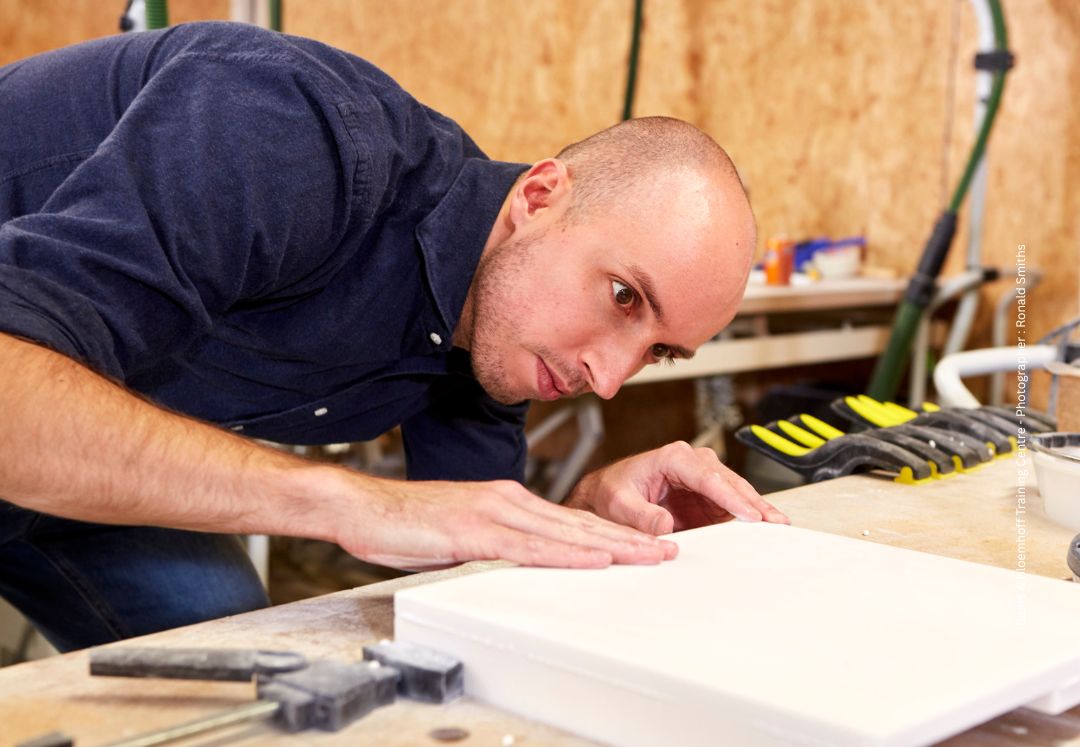
HIMACS Seaming & Joint Preparation FAQ
Q. Why is proper seaming important when fabricating HIMACS sheets?
A flawless seam ensures no visible gaps, strong structural integrity, and long-term durability. Poorly executed seams can lead to visible joint lines, cracking, or weakness over time. Achieving a perfect seam is essential for maintaining both the aesthetic and mechanical performance of HIMACS surfaces.
Q. What should be checked before machining HIMACS sheets for seams?
Before beginning edge preparation, confirm that:
The sheets are correctly positioned and aligned
They are from the same production batch for consistent colour and texture
The edges are clean, square, and free from dust or damage
Consistency and precision at this stage are key to achieving seamless joints.
Q. What is the “mirror cut” method in HIMACS seaming?
The mirror cut is the most reliable method for preparing seam edges. It involves cutting both adjoining HIMACS sheets simultaneously in a single pass using a handheld router.
This ensures perfectly matched, mirror-image edges for a precise, gap-free joint. Always maintain a clean, level surface and move the router at a steady, controlled pace.
Q. How does the “single cut” method differ from mirror cutting?
The single cut method machines each edge separately. Each sheet is routed individually with a straight edge guide, removing 1.5–3 mm of material. After both edges are cut, they must be checked for perfect alignment. If any mismatch occurs, one or both edges must be re-machined to achieve the correct fit.
Q. Can CNC machines be used for HIMACS seam preparation?
Yes. CNC cutting and nesting systems are highly efficient for repetitive or custom work. They deliver precise, identical edges and can improve production speed. Always ensure the router path is clear of clamps and use a square-based router for maximum accuracy.
Q. How should HIMACS seam edges be cleaned before bonding?
After machining:
Lightly sand rough edges with 150/180 grit abrasive paper
Remove any printed sheet identification numbers from the back
Clean edges using denatured alcohol or acetone and a lint-free white cloth
Avoid coloured cloths, as dyes may transfer. After cleaning, do not touch or contaminate the edges — even fingerprints can affect seam quality.
Q. How is a standard HIMACS butt seam prepared and bonded?
Ensure the work surface is flat, level, and dust-free.
Position both sheets with a 3 mm gap.
Seal both ends with transparent tape to prevent adhesive leakage.
Clean the edges with alcohol or acetone.
Apply a continuous bead of HIMACS adhesive and press the sheets together.
Clamp evenly — avoid over-tightening, which may cause adhesive starvation.
Allow adhesive to cure for at least 40 minutes, or until firm to the touch.
Remove clamps and trim excess adhesive with a router or block plane.
Finish with final sanding to achieve a seamless appearance.
Q. How much clamping pressure is recommended when seaming HIMACS?
Apply only moderate pressure — enough to produce a consistent adhesive bead along the joint. Excessive pressure may squeeze out too much adhesive, weakening the seam. Check for voids or air pockets before the adhesive sets and make any necessary adjustments immediately.
Q. What should be avoided when removing excess cured adhesive?
Do not use chisels or belt sanders. Instead, use a router fitted with skis or a small block plane. Belt sanders generate heat, which can compromise seam integrity. Finish all surfaces by sanding to a semi-gloss finish following the recommended guidelines.
Q. How can HIMACS seams be reinforced for added strength?
To enhance durability, apply a reinforcement strip beneath the seam:
Use HIMACS offcuts of the same thickness and colour
Sand both surfaces with 150/180 grit paper and clean with alcohol
Apply adhesive evenly and press the strip along the entire seam underside
Bevel reinforcement strip edges to 45° if exposed to heat
Clamp firmly and remove excess adhesive after curing
This reinforcement provides extra strength, especially in high-stress or heat-exposed areas.
Q. What are best practices for reinforced seams under heat exposure?
In areas exposed to heat (e.g., near cooktops), bevel the reinforcement strip edges to 45° to reduce stress points. Ensure full adhesive coverage and a tight bond. Smooth and sand all edges to prevent cracks or delamination due to thermal expansion.
Q. What is the ideal adhesive for HIMACS seaming?
Use the official HIMACS adhesive system, matched to the colour of the sheets. This ensures seamless appearance and proper bonding strength. Always prepare and apply the adhesive according to LX Hausys’ instructions for optimal curing and performance.
Q. What is the curing time for HIMACS seams?
Under normal room conditions, allow at least 40 minutes for the adhesive to cure, or until it is firm to the touch (resistant to a fingernail). Curing times may vary slightly with temperature and humidity. Do not proceed with finishing or sanding until the adhesive is fully set.
Q. Why are seams the most vulnerable part of a HIMACS assembly?
Even when properly bonded, seams remain the weakest structural point in a surface assembly due to material joins. Reinforcing the underside and following correct preparation, bonding, and curing procedures significantly improves the overall strength and longevity of the HIMACS installation.
This guideline has been created to provide technical information for successful fabrication and installation of HIMACS, and it is intended to be used in a safe environment considering their own discretion and risk by who has technical skill for fabrication and installation of HIMACS.
This guideline is continually revised to provide reliable and up-to-date information, replacing all previous versions of the guideline and technical information, however the usage and conditions of use are beyond LX Hausys control, LX Hausys cannot guarantee the suitability of material, fabrication and installation for all usage and conditions of use. Users should not regard or rely on this guideline as a complete, sole, up-to-date or absolute information. HIMACS users, fabricator and installer should review whether the design for HIMACS, fabrication method, installation method and required performance are suitable for the intended use and conditions of use. LX Hausys shall not be liable for any direct or indirect, commercial damages or losses caused by the fabrication and installation results of HIMACS using any or all these guidelines. In addition, the results of joining with other materials, and the fabrication and installation guidelines for other materials shall not be covered by LX Hausys.
This guideline does not encourage to violate any laws, patents and licenses, and cannot be used as a basis for legal liability. All works on / from HIMACS must be performed in accordance with related laws and regulations.
LX Hausys reserves the right to change the technical information and disclaimers in this guideline for technical development and further information, and the use of HIMACS or this guideline is considered to accommodate the information and changes provided in this guideline. Therefore, please check the changed details of this guideline from time to time.
LX Hausys reserves all information in this material, and no reproduction or alteration is permitted in any way for all or any part of the information without the official written permission of LX Hausys.