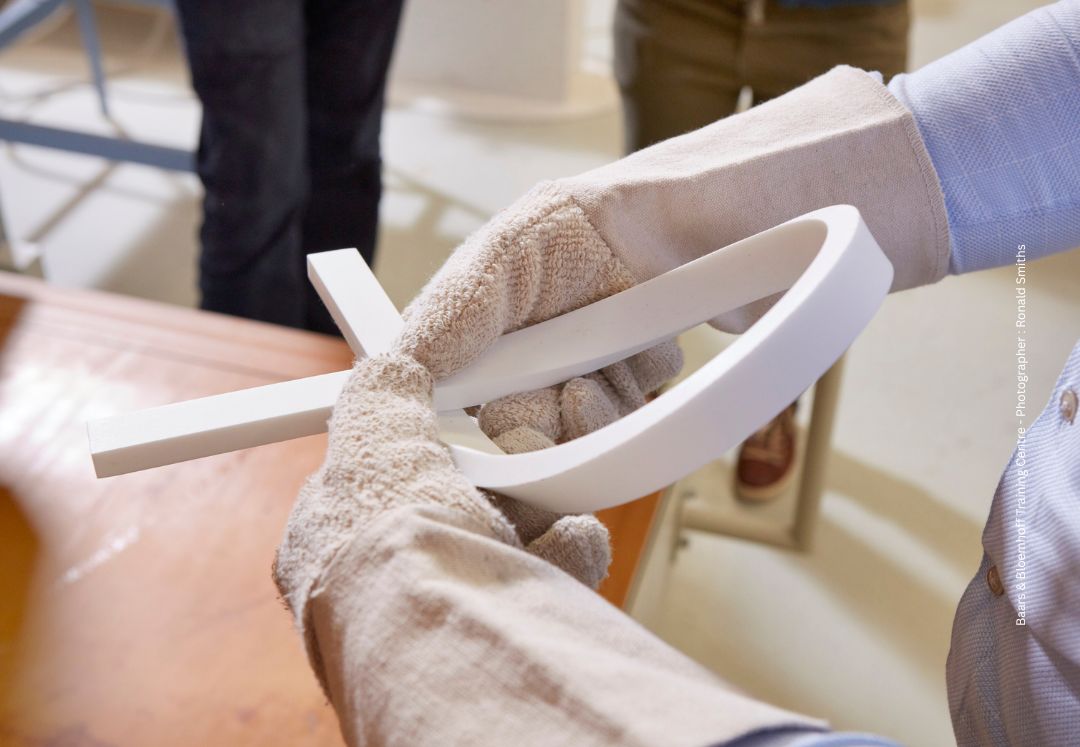
HIMACS Drop Edges & Downturns FAQ
Q. What are drop edges and downturns, and why are they important in HIMACS fabrication?
Drop edges and downturns enhance both the design and structural integrity of HIMACS surfaces. They allow for creative edge shaping through routing and adhesive techniques. When correctly fabricated, they improve the durability and aesthetic quality of the finished assembly.
Q. How should fabricators select designs for different HIMACS colours?
Design complexity should always correspond to the material characteristics of the chosen HIMACS colour. Veined, translucent, pearl, or glitter colours require different techniques than solid or fine-chip granite tones. For best results, these methods are most suitable for solid and small-to-medium chip finishes.
Q. What fabrication risks exist when creating drop edges and downturns?
Improper fabrication can lead to several issues, including:
Cracking from stress concentration.
Material failure from incompatible design.
Joint weakness due to poor alignment or adhesive use.
Thermal expansion problems causing buckling or cracks.
Colour incompatibility with special finishes.
Weak bonding from incorrect adhesives.
over-machining leading to thinning or Warping.
Following HIMACS-recommended methods prevents these issues.
Q. What is the standard method for fabricating straight components?
Straight components are easier to produce but still require precision. Sheets must be clean and dry, cuts must be accurate and smooth, and adhesives applied evenly. Proper clamping, stress management, and quality inspection ensure structural integrity and consistent visual quality.
Q. How is a drop edge fabricated using stacked layers?
For 12 mm sheets, drop edges are typically created by stacking two (24 mm) or three (36 mm) HIMACS layers beneath the main sheet. Each strip is sanded with 120-grit abrasive, cleaned, bonded with HIMACS joint adhesive, clamped at 70–80 mm intervals, and allowed to cure for about 45 minutes at +20°C before finishing.
Q. Why is the stacking method not recommended for 20 mm HIMACS sheets?
Due to thickness tolerance variations, stacking 20 mm sheets can lead to uneven edges and structural inconsistencies. This may compromise both the strength and the visual uniformity of the final product.
Q. What are the advantages of the rebating method for deep downturns?
Rebating provides enhanced bond strength, better surface quality, and cleaner edge termination compared to boot seams. A 1–2 mm rebate on the underside improves adhesive contact and reduces particle irregularities. This method is preferred for achieving professional, durable edges.
Q. How should rebating and bonding be performed for 12 mm and 20 mm sheets?
12 mm sheet: Rebate approximately 13 mm × 2 mm.
20 mm sheet: Rebate approximately 21 mm × 2 mm.
After surface sanding (150/180 grit) and cleaning with denatured alcohol, apply HIMACS adhesive, clamp every 70–80 mm, and verify continuous adhesive beads. Once cured, trim excess using a hand router and polish the surface.
Q. How should rebate depth be adjusted for different HIMACS colour families?
Large chip colours ( Volcanics, Lucia): Increase rebate depth to 5 mm.
Veined and glittering colours ( Marmo, Perna, Sparkling): Increase to 9 mm for better colour consistency and edge appearance.
Q. What are the key differences between the boot seam and v-grooving edge methods?
Boot Seam (non-rebated): Simple but less structural; used for basic joins.
V-Grooving (45° cut): Provides a mitred corner ideal for concealing colour variations. Requires accurate alignment and even adhesive coverage.
Both techniques must be executed carefully to ensure structural strength and a consistent surface finish.
Q. How is a no-drip front edge fabricated on a HIMACS countertop?
Cut a 6 mm × 6 mm rebate at the top front edge of the countertop and a matching groove in the apron so it projects 12 mm above the surface. Bond using HIMACS adhesive, cure, round over with a router, and sand to finish. This method creates a functional, seamless no-drip edge.
Q. What are the key recommendations for seam bonding and curing?
Maintain moderate clamping pressure to avoid adhesive starvation.
A visible bead should appear along the seam during bonding.
Allow adhesive to cure for at least 40 minutes or until firm.
Use a router with skis to remove excess cured adhesive.
Finish by sanding to a semi-gloss surface. Avoid belt sanders, as heat can weaken the seam.
Q. How can seams be reinforced for added strength?
Apply a HIMACS reinforcement strip (50–100 mm wide) along the underside of the seam. Use the same colour and thickness as the original sheet, sanding and cleaning both surfaces before bonding. This reinforcement improves joint strength, heat resistance, and overall durability.
Q. What are the key recommendations for internal corner fabrication?
Maintain a minimum 5 mm internal radius and keep the vertical joint line at least 25 mm from the top seam. Reinforce all edge joints with a HIMACS back block, and fabricate the worktop 1.5 mm oversize for precise trimming after curing.
Q. How are internal corners fabricated using the stacking procedure?
Prepare 130 × 130 mm HIMACS blocks, sand with 120-grit abrasive, clean with alcohol, and bond with HIMACS adhesive. Secure with spring clamps for 45 minutes at +20°C, ensuring adhesive expulsion. Reinforce vertical joints with a 50 mm wide, 12 mm thick back block, then trim, sand, and polish.
Q. What is the procedure for fabricating internal corners with extended skirts?
Use a thermoformed corner block bonded with HIMACS adhesive, clamped with spring clamps, and reinforced with a 50 mm × 12 mm back block for stability. Once cured, trim, sand, and polish to match the surrounding surface for a seamless finish.
This guideline has been created to provide technical information for successful fabrication and installation of HIMACS, and it is intended to be used in a safe environment considering their own discretion and risk by who has technical skill for fabrication and installation of HIMACS.
This guideline is continually revised to provide reliable and up-to-date information, replacing all previous versions of the guideline and technical information, however the usage and conditions of use are beyond LX Hausys control, LX Hausys cannot guarantee the suitability of material, fabrication and installation for all usage and conditions of use. Users should not regard or rely on this guideline as a complete, sole, up-to-date or absolute information. HIMACS users, fabricator and installer should review whether the design for HIMACS, fabrication method, installation method and required performance are suitable for the intended use and conditions of use. LX Hausys shall not be liable for any direct or indirect, commercial damages or losses caused by the fabrication and installation results of HIMACS using any or all these guidelines. In addition, the results of joining with other materials, and the fabrication and installation guidelines for other materials shall not be covered by LX Hausys.
This guideline does not encourage to violate any laws, patents and licenses, and cannot be used as a basis for legal liability. All works on / from HIMACS must be performed in accordance with related laws and regulations.
LX Hausys reserves the right to change the technical information and disclaimers in this guideline for technical development and further information, and the use of HIMACS or this guideline is considered to accommodate the information and changes provided in this guideline. Therefore, please check the changed details of this guideline from time to time.
LX Hausys reserves all information in this material, and no reproduction or alteration is permitted in any way for all or any part of the information without the official written permission of LX Hausys.