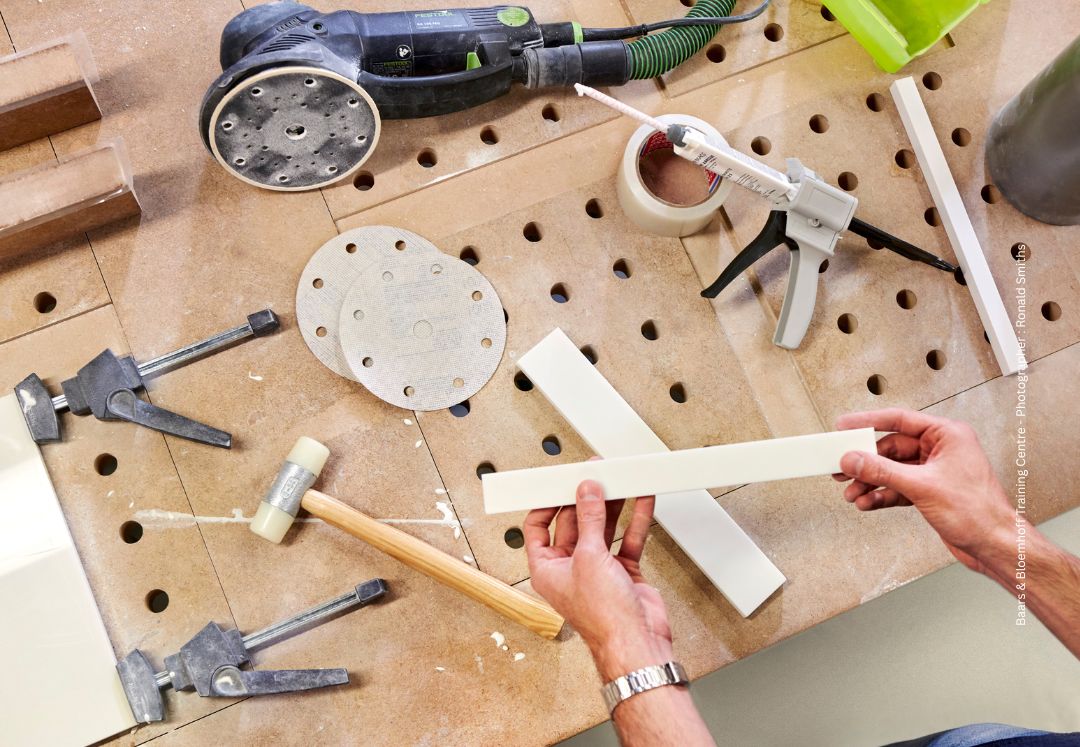
LX Hausys recommends using equipment, machinery, and tools with the appropriate power and performance for fabricating solid surface products. Although much general woodworking equipment, machinery, and tools can be used to fabricate HIMACS products, there are certain optimised features that provide better working conditions, higher quality results, and longer tool life.
This section provides a list of such equipment, machinery, and tools, along with their minimum essential specifications.
1. General workshop equipment
1.1 Dust Collection System
Dust produced during the fabrication of HIMACS products should be extracted and collected from the workplace to ensure health and safety, extend tool life, improve working conditions, and enha
A dust extraction/collection system for the entire workshop.
Dust collection attachments for each piece of equipment and tool.
Portable or mobile dust collectors for use in any location.
1.2 Pneumatic system with flexible hose and air blow gum
An air blow gun is an effective way to remove dust and residues from HIMACS products without causing scratches, both before, during, and after fabrication and installation. Using an air blow gun for cleaning can also extend the life of your tools.
It provides a quick and easy method to clean your workplace and work clothes. For this reason, it is recommended to install a pneumatic system with flexible hoses and air blow guns positioned so they can reach any required location in your workshop.
1.3 Worktable
High-quality worktables are essential not only for safe and efficient work but also for achieving the desired quality in the finished products. The optimal size and quantity of worktables should be determined according to your business scale and primary applications.
Key requirements for good worktables include:
Strength and stability – the worktable must be strong enough to support the weight of HIMACS sheets, finished products, and any work pressure applied during fabrication.
Frame materials – robust wooden or steel frames are suitable for stability. However, to prevent scratches on HIMACS products, the contact surfaces of the tabletop should be covered with a material softer than HIMACS, such as wood. Sharp edges on the worktable must be avoided.
Clamping considerations – the worktable should be designed to allow convenient and efficient clamping between the table and HIMACS products, or between multiple HIMACS pieces. The frame should minimise interference with clamping operations.
Flatness – the worktable must be level, except where a specific design requires otherwise. Stable flatness is essential for high-quality results.
2. Cutting Process
2.1 Saws
Cutting full-size HIMACS sheets should initially be carried out using a panel saw, beam saw, or table circular saw.
The basic requirements for these saws are:
Table circular saws with an adjustable, accurate rip fence and sturdy in-feed and out-feed tables.
Panel saws or beam saws must always have a dust collection system, either integrated into the machine or connected to the workshop’s system.
Minimum motor power: 5 HP (3.75 kW).
Blade speed: 3,000–4,000 RPM.
Chop saws or mitre saws capable of using saw blades with a diameter of 254 mm (10") or 305 mm (12").
All saws must have safety guards in compliance with local safety regulations.
Do NOT use the following saw types:
Handheld rip saws
Portable jig saws (sabre saws)
Chainsaws
Hacksaws
Saws that produce excessive noise and vibration
Any unsophisticated or unsuitable saw types
On-site fabrication:
During on-site work, portable circular power saws with a guide rail may be used, provided the edge is subsequently finished with a router. However, the most effective and efficient method for on-site fabrication is to use a router only, together with a straight edge and/or template.
2.2 Saws Blade
Circular saw blades with triple-chip tungsten carbide teeth provide the best possible cutting results for HIMACS sheets. The ideal specifications for these blades are as follows:
Blade diameter 254 mm (10"): 80 teeth
Blade diameter 305 mm (12"): 96 teeth
Tooth spacing: approximately 1 tooth per 10 mm of circular arc
hook angle: negative, -5°
.png)
There are many optimised saw blades and brands suitable for solid surface materials. Consult the blade manufacturer to select the most appropriate blades for your cutting equipment and tools.
Notes:
It is important to avoid stress fractures when cutting HIMACS sheets, as these can lead to cracks developing later.
If small chips or cracks appear during cutting, ensure that edges are always finished using a router or spindle moulder.
Regularly sharpen blades to maintain high-quality cuts.
For mass production and greater precision, consider using automatic equipment such as CNC machines, v-grooving machines, and diamond blades.
3. Routing and trimming
There is a wide range of routing and trimming processes due to the various applications of HIMACS products, and the required power of tools differs for each step. Therefore, refer to the following tool information for each stage of the process. The information provided is based on the tool manufacturers’ specifications. Consult the tool manufacturer to select the most suitable tool for your specific task.
Router/Trimmer | Power | Main Task / Operations |
|---|---|---|
Router 1 | 1400–1900 W (1.8–2.5 HP) | Main Task: General routing for 12 mm sheets Operations: Cutout, simple straight edge trimming, seaming preparation |
Router 2 | 2200–2500 W (3 HP) | Main Task: Heavy duty and general routing for 12 to 20 mm sheets Operations: Cutout, all trimmings and profiling |
Trimmer | 700–950 W (1–1.25 HP) | Main Task: Minor trimmings Operations: Simple edge treatment such as edge bevelling |
Routers should be capable of mounting router bits with a minimum 12 mm shank, which means the router must be equipped with a 12 mm collet chuck.
Higher power ratings of tools and machines result in more precise cuts and higher-quality fabrication. Therefore, consult the tool manufacturer and select the highest power rating available within the relevant tool category. Adequate power and RPM speed help minimise chipping and ensure accurate, high-quality cuts.
Solid surface materials are highly abrasive, and the fine dust can quickly damage electronic control contacts and bearings. It is always advisable to invest in routers with dust extraction or collection systems, or to provide good airflow and dust collection by other means. Additionally, it is important to have spare parts on hand, such as bearings, templates, and bushings.
Bits for Router & Trimmer
A variety of router and trimmer bits are available on the market. Different shapes of bits are required to achieve specific design features. LX Hausys recommends the following for routers and trimmers:
Minimum 12 mm shank for routers
Minimum 6 mm shank for trimmers
Wide selection of tungsten carbide-tipped bits for straight cuts, profiling, and basin installation
Carbide grade C-3 (minimum) or C-4 (recommended)
Profiling bits with ball bearing guides (nylon bearings are preferred)
Regularly check and maintain the condition of all bits. Inspect bits before use and ensure that spare bits are available in your workshop
Templates
Templates are essential for achieving accurate cutouts with the correct shape and smooth, clean surfaces. Templates can be made from HIMACS sheets and/or wooden materials such as MDF or plywood. LX HAUSYS recommends creating a variety of templates for sinks, lavatories, cooktops, and other applications. Templates should be stored in good condition, in a dry and clean area, to prevent deformation and allow repeated use.
4. Seaming (Clamping)
Several types of clamps are required to secure and join HIMACS products. For instance, a “basic” fabrication workshop typically needs between 500 and 1,000 hand-spring clamps, in addition to other types of clamps, to work on multiple projects simultaneously.
The suitable clamp type, size, and quantity should be determined based on your business scale and primary applications. Generally, 50 mm spring clamps and various sizes of bar (F) clamps are essential.
Please refer to the following clamps, which are suitable for the fabrication and installation of HIMACS products.
Type | Task / Action |
|---|---|
Spring Clamps | Built-up / Profiling |
C (G) Clamps | Narrow joint |
Locking (C) Clamps | Sheet, shapes, basin fixation |
Bar (F) Clamps | General usage |
Vacuum Clamping System | Flatt Butt join |
LX Hausys Recommends the Following Types of Clamps:
Steel body with steel jaws, covered by a protective surface layer
Stable fixing with easy and quick-release mechanisms
Useful Tip:
Before starting routing and jointing processes, place the clamps near your current work area. For efficient work, ensure a variety of clamp types and sizes are readily available in your workshop.
5. Finishing (Sanding and polishing)
The quality and visual appearance of the surface are the main factors representing the overall quality of the final product, as customers will notice any defects on the finished surface first. A detailed finishing process, well-trained skills, and optimized tools and machines are essential for achieving a stable, high-quality finish.
The following tools and machines are recommended for the finishing process:
Hand grinder
orbital sander
Random orbital sander
Palm sander
Hand belt sander
Stationary belt sander (wide/long belt)
Polisher
Good finishing tools should have the following features:
Minimal sanding scratch marks
Easy and quick system for attaching sanding discs and pads
Integrated dust collector or dust extraction system
Some optimised tools can deliver more efficient work in a shorter time. When selecting finishing tools, you should also consider your workshop conditions, market requirements, and personal skill level.
Air sanders are efficient for high-volume workshops due to faster sanding and longer tool life; however, they require a pneumatic system and have limited portability.
Electric sanders are versatile and commonly used in many locations, but they must be well maintained to ensure long tool life.
A variety of tools is needed to accommodate different finishing processes.
Stationary belt sanders are ideal for achieving stable, high-quality finishes on large surface areas.
Sandpapers / Discs / Pads
HIMACS products can be finished in three main types:
Matte finish
Semi-gloss finish
High-gloss finish
The name and preferred texture of each finish may vary between markets. The aesthetic quality of the finish depends on the fabricator’s skill, the quality of the tools used, and the overall finishing process applied. Therefore, it is not possible to specify exactly which type or brand of abrasive or polishing product should be used, as expectations differ across markets.
When selecting sandpapers, consider the following features:
Aluminium oxide sandpaper is typical for finishing HIMACS sheets.
Silicon carbide sandpaper is suitable for rough sanding.
Sandpaper with holes is required for vacuum dust collection/extraction.
Disc sizes of 125 mm (5”) to 150 mm (6”) are typical for hand tools.
Strong or heavy backing paper is recommended for durability.
A wide range of sandpaper grits or micron grades is necessary to achieve the desired finish.
Requirements for Sandpapers
Grit | Micron (μ) |
|---|---|
60 | 80 |
120 ~ 150 | 100 |
180 ~ 240 | 60 |
320 ~ 400 | 30 |
600 | 15 |
1000 ~ 3000 | 9 ~ 5 |
Polishing pastes and waxes can enhance the gloss level of a previously sanded surface, but they are recommended only for artistic or specialised applications.
6. Thermoforming
Heating machine (Oven)
There are two common types of heating machines:
Machines using an air-heating circulating oven (convection oven)
Machines using a heated plate oven
The type of heating machine is not critical; however, the working bed size should be considered based on the following:
Standard dimensions of HIMACS sheets
Working bed size of forming machines
Size of main finished products for your business
The following parameters are essential for the correct selection:
Heating temperature up to 190℃
Uniform heating across the entire material
Stable heating with the ability to maintain the target temperature
Quick heating with efficient power usage
Temperature control with 1℃ precision
Generally, platen heating ovens provide better performance, ensuring uniform and rapid heating of entire sheets compared with air-circulating ovens (convection ovens).
Note
Heating HIMACS sheets using direct flame is not recommended. Methods such as forge or torch burners heat the material unevenly and can burn the sheets, resulting in failed thermoforming and reduced durability.
Forming machine (Oven)
There are three typical methods for forming HIMACS sheets. One is the manual method using male and female moulds, while the other two methods involve either a hydraulic press machine or a vacuum press machine.
The hydraulic press machine is suitable for small products, such as washbasins, while the vacuum press machine is ideal for larger items, such as worktop coverings or wall cladding.
For your consideration, refer to the following information (consult the machine manufacturer for further details):
Select the appropriate press type and working bed size for your business.
Minimum 40 tonnes of pressure for a hydraulic press machine.
Minimum 9 tonnes per square metre of pressure for a vacuum press machine.
Ensure the vacuum press machine has a suitable working height for the silicon membrane.
Consider the size of the main finished products for your business.
Additional information to take into consideration
Additional tools needed for effective thermoforming
Protective gloves with insulation to safeguard hands from heat.
Temperature meter to calibrate the oven accurately.
Timer to monitor and alert the heating duration.
Moulds for forming, designed to fit the desired shape.
For large thermoformed products, a lower height vacuum press table is more efficient and convenient for handling heated HIMACS sheets.
There are many brands of heating and forming machines available on the market, and there is no restriction on brand choice. However, it is essential to ensure that the selected equipment meets the performance requirements for your specific work.
This guideline has been created to provide technical information for successful fabrication and installation of HIMACS, and it is intended to be used in a safe environment considering their own discretion and risk by who has technical skill for fabrication and installation of HIMACS.
This guideline is continually revised to provide reliable and up-to-date information, replacing all previous versions of the guideline and technical information, however the usage and conditions of use are beyond LX Hausys control, LX Hausys cannot guarantee the suitability of material, fabrication and installation for all usage and conditions of use. Users should not regard or rely on this guideline as a complete, sole, up-to-date or absolute information. HIMACS users, fabricator and installer should review whether the design for HIMACS, fabrication method, installation method and required performance are suitable for the intended use and conditions of use. LX Hausys shall not be liable for any direct or indirect, commercial damages or losses caused by the fabrication and installation results of HIMACS using any or all these guidelines. In addition, the results of joining with other materials, and the fabrication and installation guidelines for other materials shall not be covered by LX Hausys.
This guideline does not encourage to violate any laws, patents and licenses, and cannot be used as a basis for legal liability. All works on / from HIMACS must be performed in accordance with related laws and regulations.
LX Hausys reserves the right to change the technical information and disclaimers in this guideline for technical development and further information, and the use of HIMACS or this guideline is considered to accommodate the information and changes provided in this guideline. Therefore, please check the changed details of this guideline from time to time.
LX Hausys reserves all information in this material, and no reproduction or alteration is permitted in any way for all or any part of the information without the official written permission of LX Hausys.